Wikipedia gets the TrowelBlazers treatment at the NHM

The 19th October 2013 was a perfect confluence of international celebrations as far as TrowelBlazers were concerned: International Day of Archaeology, the final day of Earth Science Week, and the end of a week events surrounding Ada Lovelace Day.

Our contribution to mark all three of these things was to organise a Wikipedia editathon with the dual aims of improving wikipedia content about women in the geosciences and archaeology, and to increase the number of women editing wikipedia pages.

Trowelblazers-wiki-edit-event-1

Display of fossils and archival material relating to NHM-linked pioneering women scientists. Those covered included: Mary Anning (1799-1847), Dorothea Bate (1878-1951), Dorothy Garrod (1892-1968), Barbara Yelverton Marchioness of Hastings (1810-1858), Elizabeth Cabot Agassiz (1822-1907), Helen Muir Wood (1831-1924), Elizabeth Gray (1831-1924), Mary Home Smith (1784-1866) and (Lucy) Evelyn Cheesman (1881-1969).

With the help of the Natural History Museum’s wikimedian-in-residence John Cummings, I pulled together a whole day of activities that were open to anyone who was interested. Wikipedia training and time for editing, of course, but also a chance to meet historian Pamela Jane Smith (Dorothy Garrod expert) and writer Karolyn Shindler (Dorothea Bate’s biographer). On top of this Hellen Pethers, from the NHM library, and NHM curators Pip Brewer, Sandra Chapman and Zoe Hughes helped me put together a display of archival material and fossils collected by NHM-linked pioneer women scientists. This material is kept behind the scenes, so it was a rare and special opportunity not normally available to the general public.

Places were limited (and it was completely sold out!), but we also live-tweeted it from both @trowelblazers and @thewomensroomuk so that people could join in online. Team TrowelBlazers Suzie Pilaar Birch even joined in from a sister-wikithon in the USA:


For more details read fellow Team TrowelBlazers member Brenna Hassett write-up for the British Geological Society, and Hellen Pethers blogpost on the NHM library blog.

And the #TBwiki hashtag on twitter is well worth checking out for pictures and links from the day.

CT scanning an elephant at the Royal Veterinary College

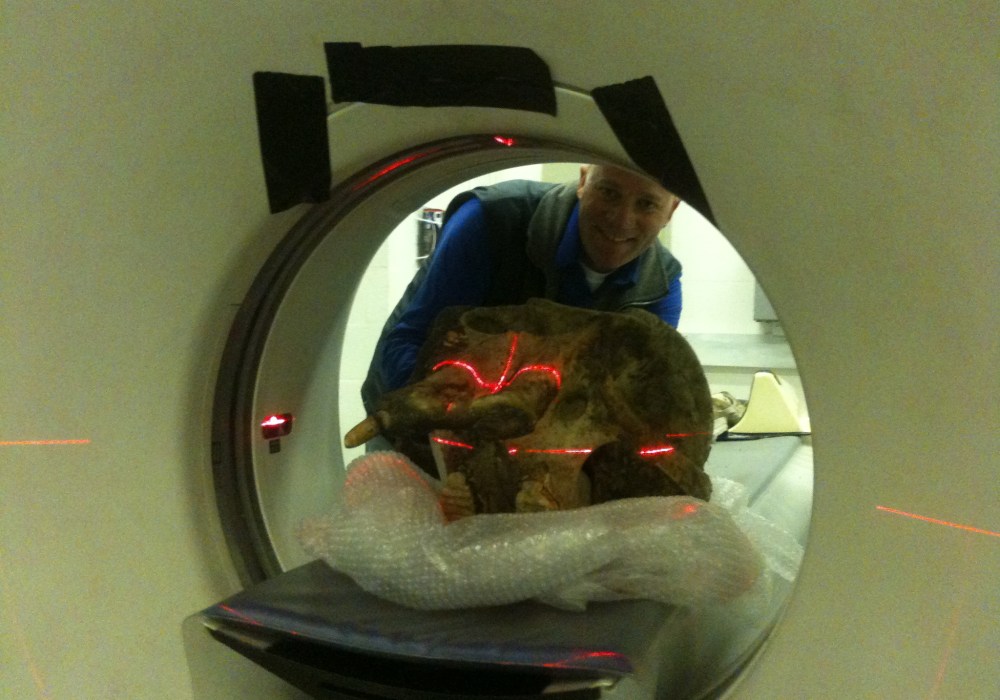
I’m part of an EU-funded project to 3D-print the skeleton of a dwarf elephant skeleton from Tilos, and one of my jobs has been to CT scan the skeleton of an Asian elephant. This is so that colleagues Evangelos and George Theodorou in Athens can use these scans to fill in any gaps they have in the dwarf elephant skeleton (for example if certain bones are missing from the fossil collections).

So yesterday I went to the RVC to scan one of the NHM’s elephant skeletons in their horse-sized CT scanner, with some help from What’s in John’s Freezer?‘s John Hutchinson. We tweeted as we went…


And of course, John-the-Hutch has a 3D printer all of his own, which I had to check out…


…before heading back to the NHM with our elephant all wrapped up. My mum came to work with me that day.

From the First Female Oxbridge Prof to Kevin Bacon in Just Six Steps…

[This post first appeared on the WISR blog]

Dorothy Garrod was the first woman to be made an Oxbridge professor. In 1939 she was elected to the Disney Chair in Archaeology at Cambridge University. At that time women were still not allowed to graduate from Cambridge on an equal footing with men, and as such could not vote on university matters, nor serve on the University’s governing council. As a Professor, however, Garrod now had this right. Through the power of her brilliant, world-renowned research, Dorothy Garrod had stormed this last bastion of male academia, nearly ten full years before it was officially ready for her. BOOM!

The myth of the lone hero

It’s pretty easy to make a hero out of Garrod. Her work really was brilliant. She really was a pioneer, leading large excavation projects in the Middle East. And as the first female Oxbridge professor, she paved the way for many more talented women to follow in her footsteps. Add to this contemporary descriptions of her as being “small, dark and alive,” and “like a dry white wine”, and the most beguiling narrative emerges of this tiny, crisp woman – armed only with her mind – taking on the pipes and the port of the male establishment, and succeeding against the odds.

Image of Dorothy Garrod from Newnham College, Cambridge: http://www.newn.cam.ac.uk/about-newnham/college-history/history/content/dorothy-garrod

Image of Dorothy Garrod from Newnham College, Cambridge.

The problem is that framing Dorothy Garrod’s achievements in this way probably says more about us, and the heroes we want, than the reality. And by ignoring the reality, we risk never truly understanding why women like Garrod came to succeed and what this might mean for diversity issues that persist in science to this day.

You see, Garrod’s uniqueness as an Oxbridge professor obscures the – perhaps even more surprising – fact that she was very much not unique as a brilliant, respected woman archaeologist in the early twentieth century. Another woman, and friend of Garrod, Gertrude Caton-Thompson had been tipped for (and possibly even offered) the Disney Chair. And Garrod’s career up to 1939 had been characterised by collaborations with other women, most famously at her all-women excavations at the palaeolithic site of Mount Carmel, in Palestine (1929-1934). On top of this, Garrod was a Newnham College fellow – she had been an undergraduate there herself before the first world war, overlapping with the classical scholar Winifred Lamb (later keeper of Greek and Roman Antiquities at the Fitzwilliam Museum), and geologist Elinor Gardner (who became a great friend and collaborator of Gertrude Caton-Thompson, and also went on to work with Garrod). At Newnham, Dorothy Garrod was both part of a community of academic women, and was responsible for training up future generations of the same. She was a key hub in a network of pioneering women archaeologists. 

This is where Kevin Bacon comes in. Linking Garrod to Bacon in six steps is more than just a very niche party trick. It provides a window into the large and complex web of connections that existed between early twentieth-century women archaeologists: women who trained each other, collaborated with each other, secured funding and jobs for each other, and who offered each other support, friendship and competition (friendly or otherwise).

Six Degrees of Dorothy Garrod

STEP ONE: DOROTHY GARROD to DOROTHEA BATE 

Archaeology is a young science. In 1922, when Dorothy Garrod wrote the book that launched her career (The Upper Palaeolithic Age in Britain, published 1926), there were just 24 professional archaeologists in the UK. In such a small field, an individual can make a large impact – and Garrod’s meticulous, comprehensive work did just that. She combined many lines of evidence to integrate the early British Stone Age with that of continental Europe. One of these lines of evidence was a study of the animal remains found at palaeolithic (“old stone age”) sites – and to do this she was helped by the fossil mammal expert at the Natural History Museum: Dorothea Bate. Bate and Garrod would go on to collaborate repeatedly throughout their careers.

STEP TWO: DOROTHEA BATE  to EDITH HALL DOHAN 

When Dorothea Bate met Dorothy Garrod she had over 20 years of research experience, and was a well-respected – if poorly paid – scientist. It was on one of her early expeditions, to Crete in 1904, that she met and befriended American archaeologist Edith Hall (later Hall Dohan). Hall was on her first excavation, digging at the Minoan town of Gournia under the direction of yet another pioneering woman archaeologist: Harriet Boyd, the first woman to direct an excavation in Greece. Edith Hall went on to a successful academic career, eventually returning to her alma mater Bryn Mawr to teach in 1921. There she trained up a new generation of classical archaeologists.

STEP THREE: EDITH HALL DOHAN  to DOROTHY BURR THOMPSON

Dorothy Burr Thompson studied under Edith Hall Dohan at Bryn Mawr, and like Hall Dohan (and Harriet Boyd) before her, went on to be a fellow at the American School in Athens (1923-5). There she excavated extensively, under the direction of Hetty Goldman (another woman!). In 1934 Burr Thompson became the first woman to be appointed a fellow of the excavations at the Ancient Agora in Athens. She continued to be part of the Agora excavation project into the late 1970s.

STEP FOUR: DOROTHY BURR THOMPSON to JOAN BRETON CONNELLY

In 1975-6, Joan Breton Connelly – then an undergraduate at Princeton; now Professor of Classics and Art History at NYU – worked as Dorothy Burr Thompson’s assistant at the Athenian Agora. This was Breton Connelly’s first excavation experience; she went on to be the director of the Yeronisos Island Excavation, in Cyprus.

STEPS FIVE & SIX: JOAN BRETON CONNELLY to BILL MURRAY  to KEVIN BACON

Yes. The actor Bill Murray has a secret alter ego as an archaeologist. He was one of the philanthropic donor-excavators at the Yeronisos Island Excavations. And, of course, Bill Murray appeared in Wild Things with Kevin Bacon.

So there you go: Dorothy Garrod to Kevin Bacon in six steps, four of which were through women archaeologists, taking in a century of archaeological research in the Mediterranean.

Six Degrees – So What?

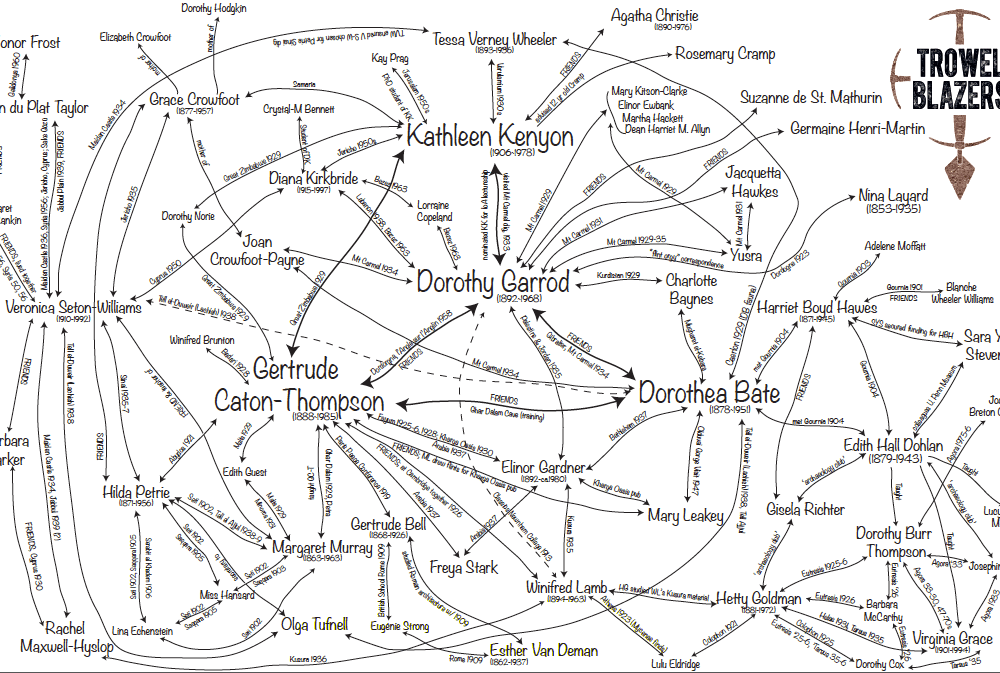
These connections only scrape the surface of the number of women working in archaeology from its inception. It would take hundreds of thousands of words to capture their achievements adequately – but it only takes a look at my network figure above to immediately grasp the scope of the number of stories still untold.

This figure came out of research for a chapter that TrowelBlazers has contributed to the Finding Ada book A Passion for Science. TrowelBlazers – a blog celebrating the contribution of women to archaeology, palaeontology and geology – was born out of righteous indignation that so many women, and their aggregate contribution to research, had been forgotten: one or two women being written out of (popular) history can potentially be dismissed as the chance loss of a rare thing, hundreds cannot.

These pioneering women did face prejudice, and they defied social convention. They had to carve out a niche for themselves, but they weren’t alone: when they weren’t allowed to study alongside men, they started their own colleges; when they weren’t allowed to dig with men, they started their own excavations. And wealth, privilege and connections gave them the power to achieve these things. In doing, they opened up opportunities for other women, and created a critical mass of women – doing top-quality research – who could have a real influence and power in a young discipline.

Today, women hold 46% of UK academic posts in archaeology. In contrast, in the biological, mathematical and physical sciences this figure is just 28%. Could this be a legacy of these early collaborative networks? If so it highlights the importance of social networks, and the emotional, practical and political support they offer, in effecting demographic change.

[You can download a full-resolution version of my Very Incomplete Network of TrowelBlazers from Figshare. Plus citation details are there.]

TrowelBlazers join forces with the Credible Superstar Role Model project

[this post first appeared on the Science Grrl blog]


“If you love [BLANK], then you’d love my job”

If someone asked you to fill in the blank in this question, what would you say? What one word or phrase could possibly capture the essence of a career in science and – simultaneously – capture the imagination of a nine year old child?

It’s the kind of question that makes my mind empty immediately. But Fiona Gill, a chemical palaeontologist from the University of Leeds, paused only momentarily before answering. Firmly, clearly, and with her face breaking into a huge grin she said,

“If you love POO, then you’ll love my job”

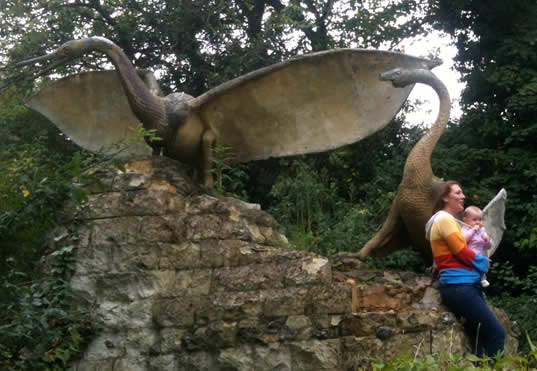
Thirty seconds later, we were all doubled over with laughter. The giant concrete Iguanadon behind us looked rather unimpressed, but then he’s looked that way -come rain or shine – for nearly 160 years.

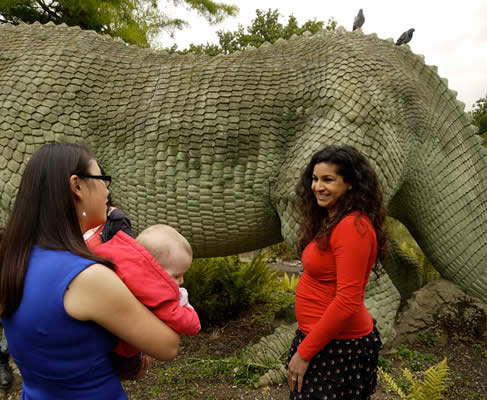
Fiona – who analyses fossil poo to work out what extinct animals were eating – was one of eight palaeontologiststs that TrowelBlazers had brought to Crystal Palace’s Dinosaur Island on the 12th September 2013 to be interviewed by Catherine Bennett, the palaeo-popstar creation of performance artist and comedian Bryony Kimmings. All of the questions in the interviews came from 9 year-olds. Our answers would be filmed and shown in schools up and down the UK. This was our contribution to the Credible Likeable Superstar Role Model Project.

“When you were 9 years old, what did you want to be when you grew up?”

I wanted to write stories; Xiaoya Ma wanted to be a dancer or an actress; Lucy McCobb wanted to be a vet. Anjali Goswami wanted to work with tigers (and she actually did for a while!). Only one of us, Susie Maidment, wanted to be a palaeontologist, and that was because someone – her Granddad – had told her that she could be, that this was possible.

The Credible Likeable Superstar Role Model Project is about opening up possibilities like this for children everywhere. It is a direct challenge to the sexualisation and commodification of childhood for profit. Its aim? To fight back against a world where little girls – and little boys – are sold a sorry story of female achievement. A world where success means fame and fame, for women, more often than not means sexual objectification. A world where Disney princesses grow up into pop sex sirens.

Susie Maidment being filmed saying that dinosaurs probably tasted like chicken or duck. And that the pterosaurs behind her aren’t dinosaurs. Photo credit: Victoria Herridge.

Bryony asked her 9-year old niece Taylor to help her invent an alternative, and Taylor’s brief was pretty awesome: a tuna-pasta eating, bike-riding popstar with very curly hair, whose songs – about changing the world, rather than love and lust – sounded like a cross between the Gorillaz and the B-52s.

Oh, and Taylor had another requirement – this popstar worked in a museum with dinosaurs.

Catherine Bennett, popstar palaeontologist, was born.

“What would you say if someone told you girls can’t do your job?”

Sometimes showing is better than telling. No, scratch that. Showing beats telling hands-down, all the time. Bryony Kimmings wanted children to understand that people like Catherine Bennett really do exist, and that working in a museum with dinosaurs was something that they really could grow up to do whether they were a boy or a girl, and regardless of their background.

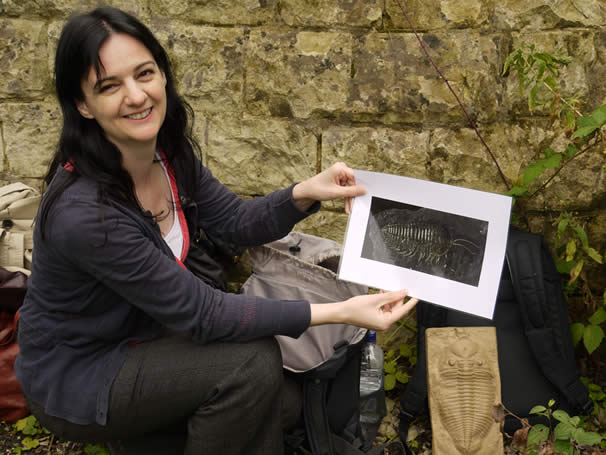
Lucy McCobb shows off her golden trilobite! Photo credit: Victoria Herridge

This is an issue close to our heart at TrowelBlazers, and so we brought together a crack-team of palaeontologists who were also great communicators, to be filmed with Catherine Bennett and show the joy and fun and diversity a career in science can bring. Because the simple answer to anyone who says a girl can’t do this job is, “You. Are. Wrong. And we have the evidence to prove it.”

Like TrowelBlazers, Catherine Bennett was born of a desire to reset imaginations. It’s about challenging the mainstream narratives of women’s lives that innevitably shape our own aspirations, and the aspirations and expectations of our children. Projects like the Credible Likeable Superstar Role Model, or TrowelBlazers, or ScienceGrrl won’t change the world all on their own, but no single project has to; everyone has their part to play.

“Just talk. Just be yourselves”

Towards the end of the day of filming on Dinosaur Island, Rebecca-the-director asked all of us to gather together and just talk to each other about our work, and our lives, so that she could film us behaving naturally.

Cue awkward silence.

Xioya Ma and Anjali Goswami, plus three dinosaurs. Only two of which are scientifically accurate. Photo Credit: Victoria Herridge.

Then, quite suddenly, the camera was forgotten. At the foot of a concrete iguanadon, as school-kids watched from across the lake, eight scientists laughed and shouted and debated, and the conversation flew from 1m-tall dwarf elephants to 2m-long giant millipedes, de-extinction to dinosaurs.

And looking around the group of women and men assembled, who had come from across the UK to do this simply because they cared about the next generation of palaeontologists, I felt quite extraordinarily hopeful. Gender stats in science are bad; those for ethnic diversity and socio-economic background are far worse. And yet there is such a will to change things – we just need to harness it.


Catherine Bennett (@RealCB)’s  music videos are here (they’re catchy!)

Bryony Kimmings’ Credible Likeable Superstar Role Model (Winner, Fringe First Award 2013) will be on at the Soho Theatre 8th-26th October. Book tickets here.

With huge thanks to Bryony, film team Rebecca Brand and Daniella Cesarei, thePalaeontological Association, and Stephen Tickner from Bromley Council for making all this possible.

Top photo: Palaeontologists assemble on Dinosaur Island. Left to right: Susannah Maidment (Imperial College London), with Amber; Fiona Gill (U. Leeds); Liam Herringshaw (U. Durham); Anjali Goswami (UCL); Lucy McCobb (National Museum of Wales); David Legg (Oxford University); Xiaoya Ma (Natural History Museum, London); Victoria Herridge (TrowelBlazers) and Catherine Bennett. Photo credit: Daniella Cesarei

TrowelBlazers is Launched!

It’s easy to imagine the academic world at the turn of the 20th Century, right? A world closed to all but the most privileged of men – whiskered gentlemen in stiff suits, pipe smoke and port, explorers with a whiff of pith helmet about them.

Imagine, then, arriving on the island of Crete in 1904 to find not one bold, brave young woman researcher digging up the past – but four: Harriet Boyd, Blanche Wheeler, Edith Hall and Dorothea Bate.

Or the Arabian Desert in 1900, where that striking figure riding towards you, headscarf billowing, at the head of a caravan of camels is not Lawrence of Arabia – he was barely out of short trousers then – but Gertrude Bell.

Try archaeology* in the interwar years, then. In our popular imaginations this is proper Indiana Jones territory. But in 1929, on the far eastern edge of the Mediterranean Sea, Dorothy Garrod was leading an excavation team of five women. Over the next five years, in caves dotting the steep-sided cliffs of Mount Carmel, Garrod’s team would uncover remarkable remains of Neandertals and some of earliest evidence for modern humans outside of Africa.

There were many, many women archaeologists, palaeontologist and geologists in the 19th and early 20th Century who were well known and respected – then – for their work and achievements. Now, however, they have been forgotten. This isn’t totally surprising – after all, how many men from those fields are household names? But it’s more than just forgetting a name or six; we’ve failed to retain the idea that women like these formed a significant – if under-represented and often resented – part of the cultural and academic landscape. We’ve allowed them to slip from our popular consciousness.

It’s a cautionary tale.

Fast forward to today. Women are a significant, but under-represented, part of the cultural and academic landscape (sound familiar?). Like our predecessors, we face institutionalized prejudice and inequality, even if our individual work is respected. In fifty or a hundred years time, will our existence and contributions have made as small a dent on people’s imaginations as the women of yesteryear?

Not if we can help it! On Friday we launched the TrowelBlazers tumblr blog** to carve out more space on the Internet for the story of women’s contributions, past and present, to the fields of archaeology, palaeontology and geology (authors note: we aren’t above a spot of land grabbing, and given field-boundaries are a tad blurry and multi-disciplinary study common, we will also be featuring women geographers, explorers and anthropologists).

By scouring the Internet and beyond for images and videos, and posting them alongside short, readable snippets of information, we want to reset people’s imaginations. As the blog grows, we hope that the volume of entries – as much as the individual stories – will be its own powerful testament to just how significant these women were, and continue to be.

Because it isn’t just the derring-do of pioneer-era women we are interested in, we want to celebrate the full diversity of trowel-blazing women working today, from all backgrounds and from all parts of the world. On top of this, we want to highlight the networks of women that have worked together over the years – something often lost in heroic tales of success against the odds, where women are inevitably framed by a world of men.

It’s quite an agenda we’ve set ourselves, and we need help building up this picture. We aren’t historians of science – we are learning too – and we know that we haven’t even scraped the surface of the awesomeness of these trowel-wielding women (even if we are quite proud of our spreadsheet with nearly one hundred women on it already). Anyone can submit a post to our blog, or join in the conversation on Twitter and Facebook. Together, we can showcase the aggregate contribution of these trowel blazers.

One exception to the rule can be dismissed, many exceptions cannot. In essence, that is the spirit of TrowelBlazers, served up with a dash of ancient wonder, a sprinkling of adventure and – of course – buckets of mud and sweat.

TrowelBlazers is run by Victoria Herridge (@ToriHerridge), Suzanne Pilaar Birch (@suzie_birch), Rebecca Wragg Sykes (@LeMoustier) and Brenna Hassett (@brennawalks). They all also tweet at @trowelblazers.

* Yes, archaeology is a science (some bits more than others), but we are interested in women beyond the realms of science as well.

** in May 2014 we moved to our new internet home, trowelblazers.com


Charles Lyell Award Lecture at the British Science Festival

What do dwarf elephants have to do with climate change?  Charles Lyell Award Lecture by Dr Tori Herridge, 2012 British Science Festival.

This year I was nominated by the Palaeontological Association to give the Charles Lyell Award Lecture at the British Science Festival. To be nominated by my colleagues was honour enough, so actually being selected by the British Science Association meant my sci-comm cup overfloweth…

It was also rather cool that this year marked the 150th anniversary of the first scientific description of a dwarf elephant — at an earlier British Science Festival, no less [read more about that here].

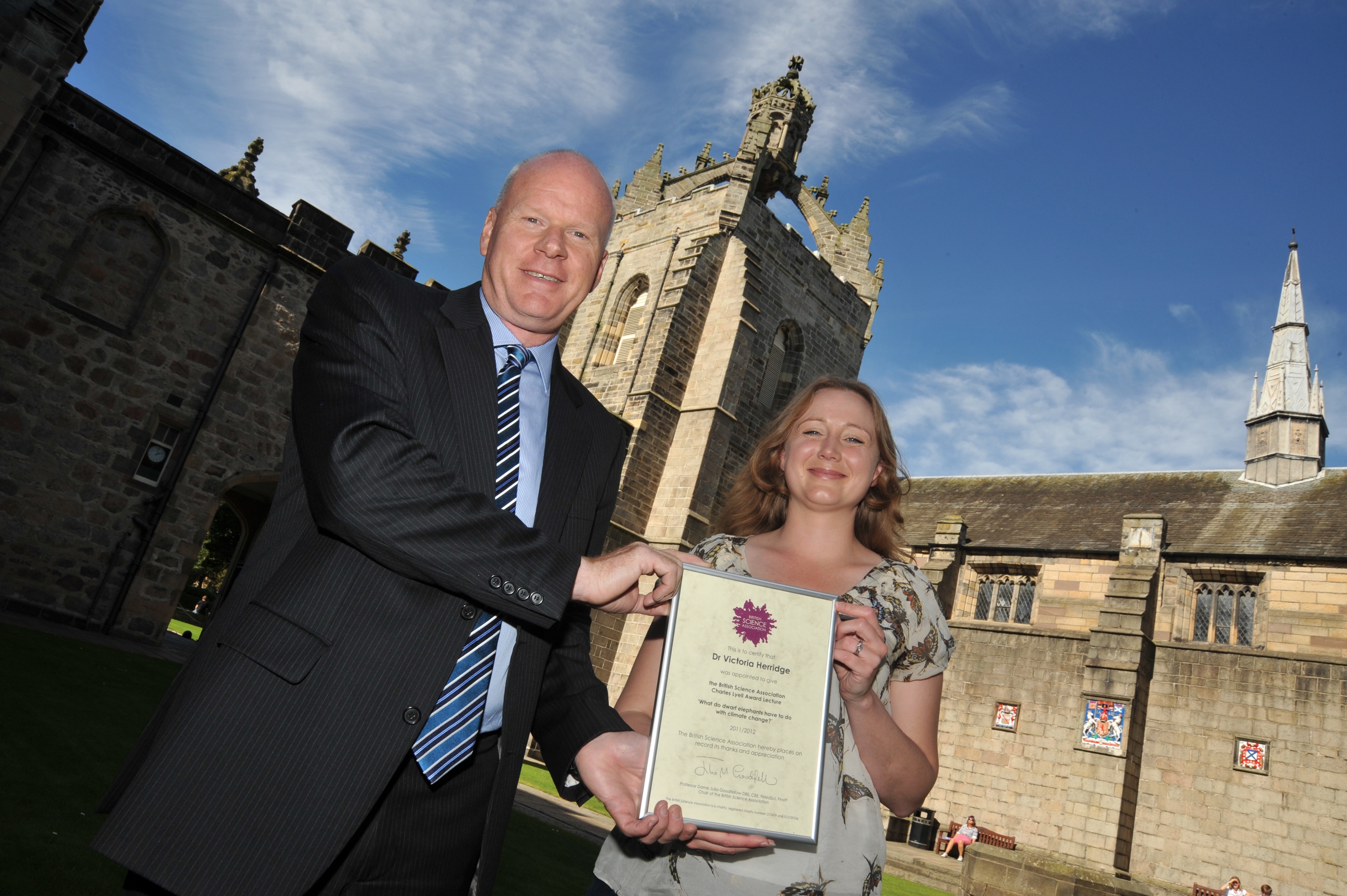
Receiving my award certificate on a gorgeous day at the very beautiful Univeristy of Aberdeen! Photo (c) British Science Association.

Receiving my award certificate on a gorgeous day, at the very beautiful Univeristy of Aberdeen! Photo (c) British Science Association.

The talk had to be at least 25% interactive, and suitable for families. So I had a fun time inventing demos to explain sea level change in the ice age and concepts like Island Biogeography in a child-friendly way. It was a little perplexing when the audience filed in and there were absolutely no children at all, but I think everyone had a good time. After all, who doesn’t love a demo which involves a tyvek CSI suit and a bottle of spray cream…?

A Who’s Hugh of Aberdonian Science…

[this post first appeared on the British Science Festival Blog]

What do you get if you put Aberdeen, the British Science Festival, and dwarf elephants together? Isn’t it obvious? Hugh Falconer.

What do you mean you’ve never heard of Hugh Falconer? The man who was instrumental in introducing tea plantations to India? The man who, in 1842, brought back five tons of fossil bones to the UK from Pakistan and India, fossils which would eventually form a core part of the Natural History Museum’s collections? The man who Stephen J. Gould claimed was the first scientist to anticipate the evolutionary theory of punctuated equilibrium? Not ringing any bells? Poor Hugh Falconer – one of the most respected scientists of his day, but now he is largely forgotten.”

Well this year, at the British Science Festival in Aberdeen, it is time to remember him. Not only did Falconer began his academic career studying Natural History at the University of Aberdeen (class of 1826), but this year is also the 150thanniversary of the first-ever scientific description of a species of dwarf elephant. Guess who described it? Yep – Hugh Falconer, and he did so at the 1862 Annual Meeting of the British Association of Advancement of Science, the forerunner of today’s British Science Festival.

As if that wasn’t coincidence enough, I am bringing dwarf elephants (or, at least, their fossilised remains) to the Festival, just like Falconer did back in 1862, to talk about their evolution and what we have – and haven’t – learnt in the last 150 years.

Falconer’s dwarf elephant fossils, which he called Elephas melitensis, were from Malta. Other dwarf elephant species (all sadly extinct) have since been discovered on Malta, Sicily, Sardinia, Crete, Cyprus and many of the small Greek islands (like Rhodes and Tilos), as well as on the Californian Channel islands and on Wrangel Island in northeast Siberia. They are an example of the phenomenon known as the ‘Island Rule’, where big animals evolve to get smaller, and small animals evolve to get bigger.

Descended from a 4m-tall, 10-ton extinct species of elephant known as the straight-tusked elephant, Falconer’s elephant would have stood just one metre tall as an adult, the size of a newborn African elephant today. Living alongside it on Malta were a giant dormouse, and a giant swan that probably topped the little elephant in height (the swan, that is – the thought of this, I must admit, scares me slightly). I’m interested in understanding how and why elephants evolved to be smaller on islands, and to help do this I am gathering evidence to find out how old the fossils are. We think most of the Mediterranean dwarf elephants lived sometime between 800,000 and 10,000 years ago, but we lack more exact dates for each species. Once I have this information, I’ll be able to place the dwarf elephant fossils into the context of the climate changes of the past, and see whether these were important to their evolution and extinction.

There’s good reason to suspect climate change might have been important, because these dwarf elephants mostly evolved during a period characterised by big climate fluctuations, with warm stages (like today) switching to ice ages, or ‘glacials’, every 100,000 years. Glacial climate, as Hugh Falconer wrote to Charles Darwin (in September 1862, in fact), was “. . . no joke: it would have made ducks and drakes of your dear pigeons and doves”, but for islands it had another significant effect: the sea level would drop as water became frozen at the poles, opening up routes to islands, and increasing their size. With the converse being true of warm stages, it is immediately apparent that the island environments, and the species living on them, could have been affected by these fluctuating climate changes. In my talk at this year’s Festival, I will be exploring this further, with some help from the audience.

There wont be much room for Hugh Falconer in my talk, but it’s his work from 150 years ago which underpins it. So if you’re in Aberdeen this September, please do spare a thought for the boy from Forres who became a man of science in Aberdeen and did so much more for science than just describe a species of dwarf elephant. File him in your mind alongside Darwin, Hooker, Huxley, Lyell and Owen – he managed to fight with them all at one time or another – and think of him each time you have a cup of tea. And if you can spare the time either side of the Festival, go to the Falconer Museum in Forres to find out more. It’s only a couple of hours up the road, after all.

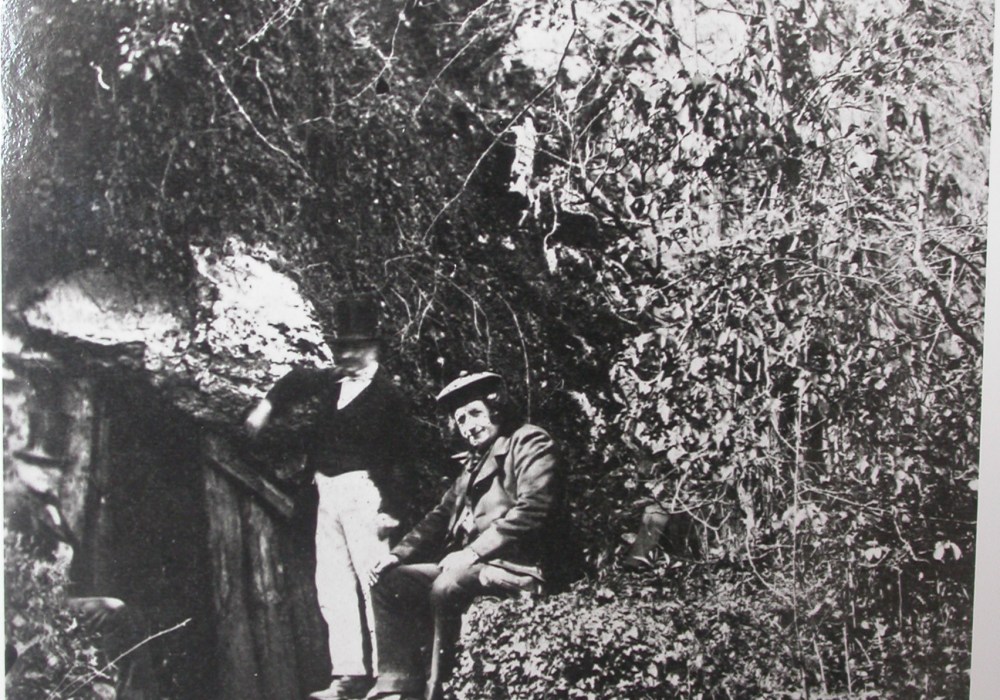
Image Credit: Hugh Falconer (seated) with a very dapper William Pengelly in front of Kents Cavern in Torquay (an important fossil mammal locality), April 1858. Copyright: Forres Museum.

Hunting for Hugh Falconer’s notebooks in Forres…

Hugh Falconer was the first person to describe a dwarf elephant (150 years ago, in 1862). He was pretty terrible at publishing however, and this is making my work on sorting out the messy state of Sicilian and Maltese dwarf elephant taxonomy rather tricky.

After his death, his friends turned his notes and letters into a book as a way to make up for his lack of lifetime publication. It ran to two thick volumes! There must have been a huge pile of papers and notebooks – but the originals seems to be lost. I went to the Falconer Museum in Forres to see if anything was hiding in the archives.

Forres, by the way, is better known for its association with Shakespeare’s Macbeth: Duncan’s castle was in Forres, and the three witches toiled and troubled thereabouts. Judging by the witches stone on my walk to the museum, they’d have met a sorry end had the locals got hold of them.

Witches Stone, Forres. Inscription reads: ‘From Cluny Hill witches were rolled in stout barrels through which spikes were driven. Where the barrel stopped they were burned with their mangled contents. This stone marks the spot of one such burning.’ Nice.

I didn’t find the note books, but I did get to see some other rather wonderful things that really brought Hugh F to life for me, in all his larger-than-life glory. He sounded like he was a lot of fun, rather infuriating at times, but loyal and loving (if a little unreliable!)…

If anyone has any thoughts as to the whereabouts of Hugh’s notes, do let me know. I’ve checked with the archives of George Busk (his great friend) and Charles Murchison (who edited the Memoirs and Notes of HF), and looked in the NHM archives. I’ve also asked at Edinburgh and Aberdeen university, and the Linnean Society. Some letters survive in the Darwin archive (they are very poignant… poor Hugh seems to have waited in rather wistfully for Charles D to visit, only to be continually disappointed), but otherwise I’m at a dead-end.

Anyway – a few treats from Hugh Falconer’s archive, courtesy of the Falconer Museum in Forres (which you should visit if ever you’re in Scotland). All photos are (c) Forres Museum.

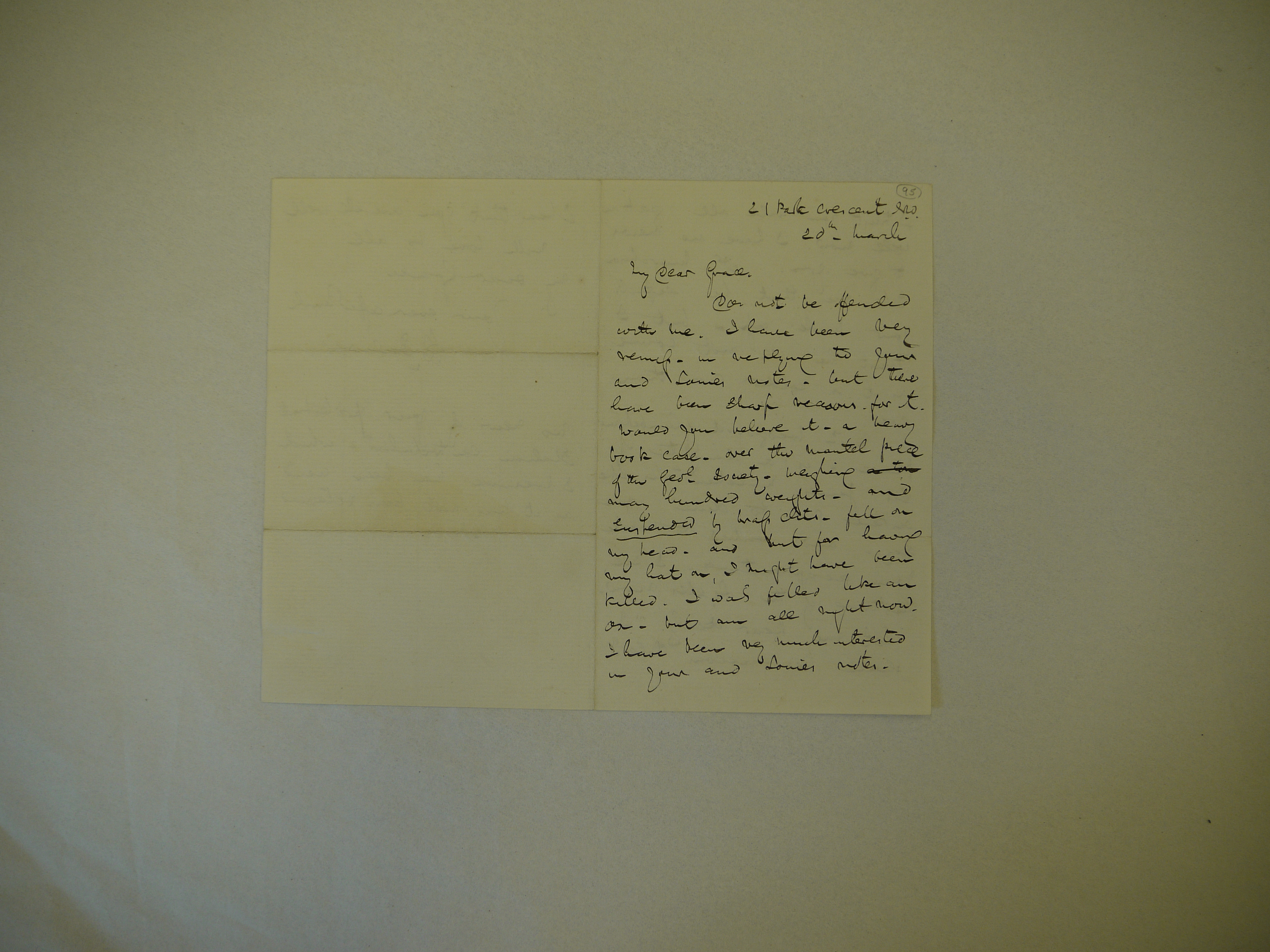
HF survives an incident at the Geological Society, thanks to his hat. Letter to his niece Grace.

HF survives an incident at the Geological Society, thanks to his hat. Letter to his niece Grace.

P1040551

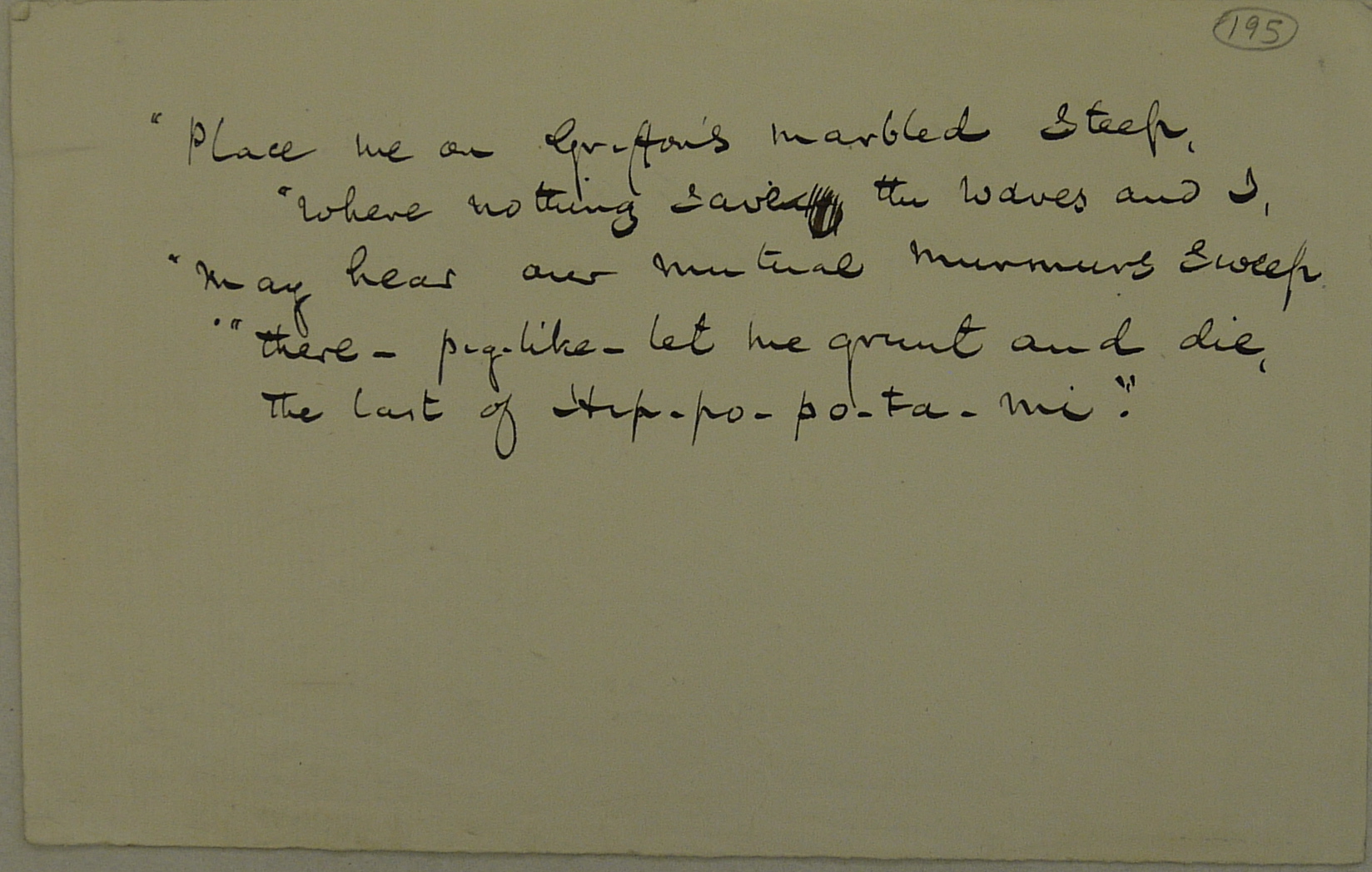
HF identifies with a hippopotamus.

San Ciro Cave, in Sicily.

San Ciro Cave, in Sicily.