Mammoths in the Media

A quick round-up of the last two-and-a-bit weeks of Mammoth Media Madness, where on more than one occasion I found myself thinking ‘What would Peeta Mellark do…?’

It all started with Woolly Mammoth: the Autopsy…

(NB. in the UK, you can watch this on 4oD here)
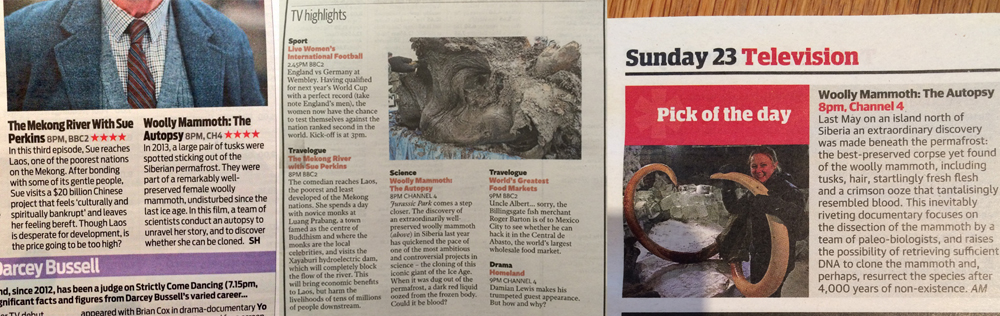
The Daily Mail, the Independent and the Guardian all thought you should watch Woolly Mammoth: The Autopsy on Channel 4, Sunday 23rd November 2014

The Daily Mail, the Independent and the Guardian all thought you should watch Woolly Mammoth: The Autopsy on Channel 4, Sunday 23rd November 2014

Which led to an early morning trip to Media City in Salford, to talk mammoth blood on the BBC Breakfast sofa (and they squeezed a cheeky Radio 5 Live segment in on the way up the stairs too!). There was a whole plate of pastries for breakfast but neither I, nor the teachers who were divided about the controversial issue of whether kids should give their teachers christmas presents, wanted to eat them.

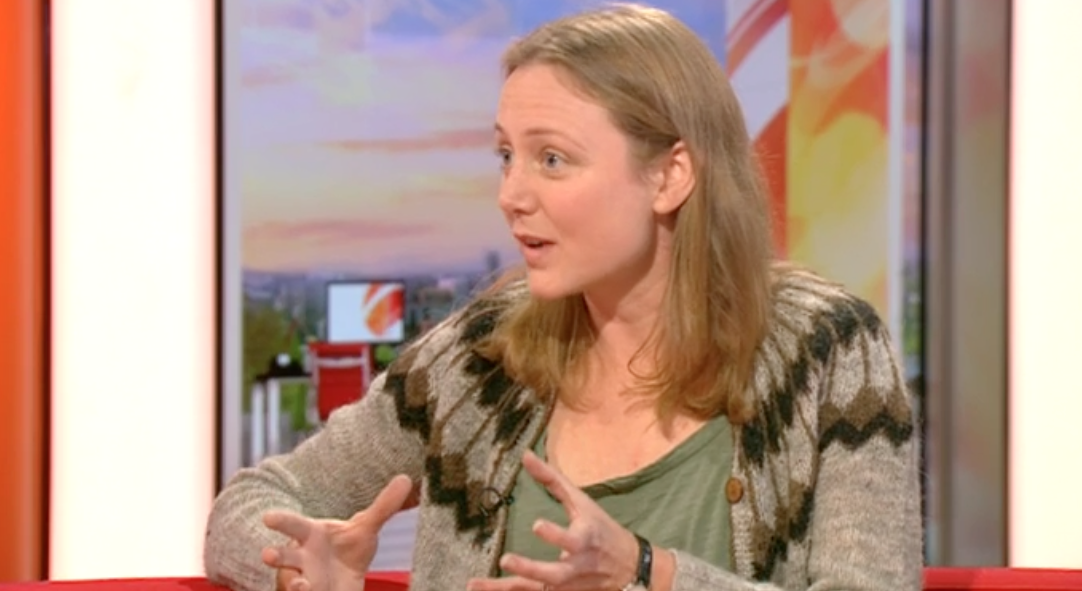
Screen Shot 2014-12-07 at 12.56.15

On the BBC Breakfast Sofa, wearing my apple-scratting, cider-making clothes (all I had with me that weekend…)

On the BBC Breakfast sofa, wearing my apple-scratting, cider-making clothes (all I had with me that weekend…)

And then I wrote about the ethics of mammoth cloning for The Guardian’s Comment is Free [more here], which prompted a lot of other journalistic pieces, with comments from me.  Too many to link to.

Screen Shot 2014-12-07 at 13.05.09

This was followed by an invite to go on BBC Radio 4’s Saturday Live. I said ‘Yes, please!’ [listen here]

No one wants to eat the Saturday Live pastries… From left to right: John Carder Bush, Rebecca Root, Carrie Grant, and me.

No one wants to eat the Saturday Live pastries either… From left to right: John Carder Bush, Rebecca Root, Carrie Grant, and me.

Then Russell Howard’s Good News got in touch. I was terrified, but thought what the heck. They uncovered my #RealorAuel secret, and it all got a bit cheeky, but it was great fun. Russell Howard is a very generous comedian, who let me take the mickey out of him as much as the other way round. [available here in the UK until 01:30, Thurs 11th Dec. Rest of the world, this link should work for you]

Russell Howard and I discuss the finer points of etiquette when sharing a bedroom with one's clone...

Russell Howard and I discuss the finer points of etiquette when sharing a bedroom with one’s clone…

Plus they give you flowers!

Flowers, crisps, chocolates and pizza to order in the Russell Howard's Good News dressing room!

Flowers, crisps, chocolates and pizza to order in the Russell Howard’s Good News dressing room!

And then I got flown to New York for an interview on CBS This Morning to promote the Smithsonian Channel version of #mammothautopsy How to Clone a Woolly Mammoth.

I got picked up in a limousine…

One of four limo trips through NYC. Must say BBC Breakfast didn't stretch (*groan*) to this ;-)

One of four limo trips through NYC. Must say BBC Breakfast didn’t stretch (*groan*) to this 😉

And the CBS This Morning green room had a pretty fancy breakfast spread… But what is it with breakfast TV and pastries? Who on earth wants to go live on national TV with pastry crumbs down their front or stuck to their lipgloss?
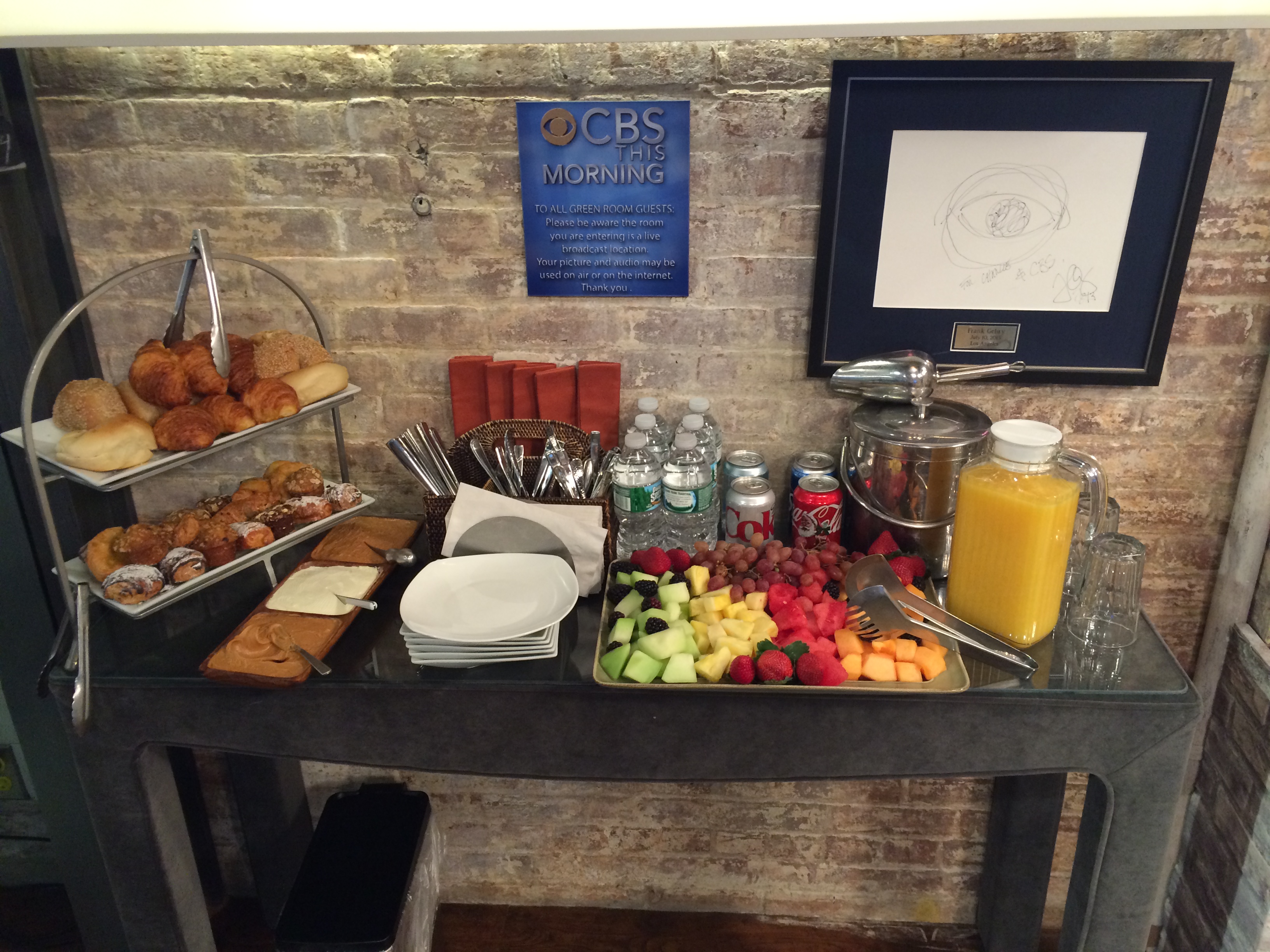
CBS This Morning puts on a good breakfast spread. Nobody wants to eat the pastries, again.

CBS This Morning puts on a good breakfast spread. Nobody wants to eat the pastries, again.

American production values made me look very [lip]glossy. I’m glad I wore my fave cider-making cardy again to make sure a bit of the real me made it on-air. Plus, breakfast is a cosy cardigan kind of time.

You can watch the CBS This Morning interview here: http://www.cbsnews.com/common/video/cbsnews_video.swf

Thanks dear chum Anna Zecharia for getting her entire US family up early on the day after Thanksgiving to record this for posterity!

Thanks dear chum Anna Zecharia for getting her entire US family up early on the day after Thanksgiving to record this for posterity!

I also got to meet up with my Team TrowelBlazers buddy Suzie Birch in NYC after the interview, so that was a bonus!

Suzie Birch and I catching up in Central Park, NYC. Nice selfie work there, Suzie!

Suzie Birch and I catching up in Central Park, NYC. Nice selfie work there, Suzie!

And the icing on the ridiculous cake? I made it into Grazia’s Chart of Lust. One below Morrissey. Oh Yes.

Number 7 on Grazia's Chart of Lust. Surely life is downhill from here?

Number 7 on Grazia’s Chart of Lust. Surely life is downhill from here? Thanks Nicola Hembrey for the pic!

It’s been a ridiculous whirlwind of a time. Exhausting and hilarious. Hopefully informative on the science front to all who paid attention, and didn’t get totally sick of me.


Postscript: one of the things that freaked me out about all this TV was having no idea about the practicalities of what’s involved in different settings: the studio set-up, what to wear, what to bring with me etc. For example, I don’t normally wear make up except for special occasions, but I’m vain/self-conscious enough to not want to look crap on the telly, so should I arrive with my make up done? Or bring it with me?

Here’s some knowledge I’ve gleaned that may be useful to others in the same situation:

1. I had to sort myself out hair/make-up/clothes-wise on #mammothautopsy. This meant I got stuck wearing the same boiling hot outfit for a week (for continuity) as we launched into the autopsy and filming earlier than I expected. I had my hair up, fortunately, so that wasn’t flopping around everywhere. But I don’t recommend a hand wash-only cardigan as suitable mammoth autopsy attire… Or necklaces.

2. If you go to a TV studio, they will do your make up and hair for you so you really don’t have to worry. This is very important for morning tv when you don’t really want to be arsed getting up even earlier than you have to and then have an eyeliner crisis or whatever. How much make up they put on you varies, though, so I imagine having some idea of what you want to look like might help. If I’d been braver, I might have asked for a leetle less of the slap on Russell Howard. Though as it just brought me in line with Russell — yes blokes, you’ll be getting the treatment too, as Steve says below — I suppose it was  beauty-base zero, as they say in the Capitol. The CBS ladies were the best, as they sized me up and realised I wasn’t a make-up person, so kept it minimal. BBC Breakfast kept it minimal too, but I think that was mostly because we had literally 30 secs to get ready and the make-up artist was also busy eating a pastry with one hand. Still, at least someone’s eating those pastries 😉

3. Food. They will promise to feed you, but for breakfast TV & radio it will be pastries. And there won’t be any plates (I sound like my mum!). Fine for radio, but these have to be the worst food EVAH for a pre-broadcast snack as they’re so messy. I’d make sure you have breakfast first, if you aren’t too nervous.

4. Clothes. Apparently blue and green are frowned upon by RHGN (and any green-screen setting too), which was a disaster for me as that is basically my entire wardrobe (apart from Scandinavian knits..). Also crazy patterns, stripes and checks cause strobing issues. I had to dash out at lunch and buy a not-very-expensive red top from Zara. I recommend Icelandic cardigans wherever possible, except at mammoth autopsies.

5. It helps, I’ve found (also when doing live events), to wear something with a waistband that they can attach the mic battery pack easily. So skirt/trousers/dress with a belt. Otherwise you might find yourself fiddling with the waistband of your tights in fairly public settings…

I should also add that all of the producers I dealt with were super-nice, and super-kind. Thanks especially to Trudy Scanlon at BBC Breakfast and Ben Michaels at Russell Howard’s Good News for dealing patiently with all of my questions and being all-round good eggs. I even forgive you for the Mammoth Hunters excerpts, Ben — reading the books to find the juicy bits is punishment enough!

The ethics of mammoth cloning: UPDATED

I wrote about the ethics of mammoth cloning for the Guardian’s Comment is Free pages. You can read what I think here.

A quick update: Although in this interview with the Naked Scientists, George Church directly discusses elephant surrogates, I’ve just heard on the grapevine that he now intends to only use artificial wombs. I’ve emailed him to find out if this is true. Will update as soon as he answers.

In the mean time, I’ve asked the editors to add in a ‘probably’ to add some necessary ambiguity over the use of Asian elephant surrogates.

I’m not sure how I feel about this. Would I want to see a cold-adapted Asian elephant in Siberia if no animals were involved in the experimentation? It raises a different set of ethical questions, and I’m still thinking about it.

But one thing it doesn’t change is my scepticism over this plan of action as a feasible tool to mitigate climate change. Artificial womb technology seems a long way off, extending the timescale over which we can expect to see a viable cold-adapted Asian elephant in the world.

Even *if* the reintroduction of cold-adapted Asian elephants could do what its proponents hope — and we don’t know that it will — the time taken to genetically engineer, and artificially gestate elephants in the numbers that would be required is going to be considerable. And I doubt we have that kind of time when it comes to climate change. I’d like to see some well-thought out data and modelling on this, rather than romantic daydreams.

**UPDATE**

George Church kindly and very patiently replied to my questions. What follows is some incredibly mind-blowing science and a number of extremely good points. I’m digesting them still, and I’ll leave you to make up your own mind…

The answer to your question is: Yes.  Someone may use a surrogate elephant mother, if the chances of success are high and the expected benefits for the species survival/diversity are high (for example, due to extended geographical range).  My group will be working hard on alternatives, but it would be premature to guess at the exact state of rapidly progressing reproductive technologies years in the future. 

Getting full mammalian development to work in vitro is important for may reasons (testing hypotheses, testing drugs, tissue, transplantation, developmental biology, etc.)  Most vertebrates develop outside of a parental body.  For mammals, there are at least two options: 1) running blood directly through an umbilicus or 2) running blood through a placental interface.  We just published some relevant new technologies: 1) CRISPR activators which allow epigenetic reprogramming  and 2) in situ sequencing which allows analysis such reprogramming for closeness of fit to natural equivalents, 3) CellNet software to decide on multiple regulatory adjustments.  Automation allows us to optimize numerous parameters simultaneously.  It is hard to estimate how long this will take, but we have been pleasantly surprised few times recently, with technology arriving far sooner and better than expected (e.g. next-gen sequencing and CRISPR).

“You and I seem well aligned on this [GC is referring to my op-ed CiF piece]. I would certainly prefer to not interfere with Asian elephant healthcare, except positively.   My lab’s success already in using CRISPR on Loxodonta fibroblasts has not hurt elephants and hopefully will help in understanding their biology.  The costs and quality are improving rapidly since the protocols are being debugged in the context of experiments focused on human and mouse.  We are exploring methods to go from mammalian stems cells to embryos to babies, with inexpensive automated processes and high efficiency. If this works for mouse and pigs, then similar endeavors could be made for elephants.  This should help (rather than hurt) reproductive efforts for these precious species.  If we are successful in making cold-resistant versions of Asian elephants, then that might further help conservation efforts by allowing them to occupy locations with very low human population density and abundant vegetation.

“[I say in my CiF piece] ‘making a genetically engineered elephant that can handle the cold – this just isn’t as emotionally satisfying as … taking an actual mammoth cell nucleus’.  But, neither route is the “real thing”.  The frozen nuclei have been lethally irradiated for 10,000 years — broken to tiny pieces, while the synthetic DNA is unbroken and hence more like “real” Mammoth DNA.  If we are face-to-face with an animal containing such DNA and that looks like Mammoth and thrives at -50 degrees, I’d be surprised if we would be emotionally unmoved.”


**George Church is interviewed quite extensively in Woolly Mammoth: the Autopsy, so well worth watching to hear what he has to say on the matter: 8pm, 23rd November on Channel 4**


Educating 21st Century Women Conference

10th September 2014: Four hundred 15 year old girls, arranged around fourty-odd tables, in the lecture hall at the Queen Elizabeth II Conference Centre. And a Tardis. This was the Educating 21st Century Women conference, and I was attending as a panel speaker.


The conference was organised by Mulberry School, a truly wonderful non-selective, all-girls state school in Tower Hamlets, one of London’s most deprived boroughs. The diversity of uniforms in the room, however, was testament to the fact that girls from all over southeast England were in attendance. The atmosphere was electric, but focussed. That morning they’d heard from Mamma Mia and The Iron Lady director Phyllida Lloyd and choreographer Shobana Jeyasingh, amongst others, about gender issues in the Arts and Broadcasting. My panel, on STEM careers, was up next. So, no pressure…

Alongside me on the panel were Lady Geek’s Belinda Parmar, Teach First’s Ndidi Okezie and Pathologist Professor Paola Domizio. Kirsten Bodely from STEMNET chaired.

Questions from the floor focussed on our career paths – how we came to do what we do, the challenges faced along the way, and what advice we’d give to girls today. Apart from the horrified gasp from the room when I told the story of me dropping arts in favour of science subjects at A Level because the course-work got in the way of my teenage social life (I’m not proud and think this May have been a big mistake), I hope my advice was sound. This is what I tried to get across:

  • be honest with yourself about what you want out of life — don’t waste your time chasing other people’s dreams for you, however well intentioned they may be.
  • don’t allow other people’s ideas of ‘success’ to define you (see above).
  • if you don’t know what you want to do, then focus your efforts on what you are good at and what you enjoy. Work at them. That ought to bring you to a place where you have a good chance of being happy.
  • Be proud of who you are, and where you came from. Don’t apologise for your origins. But equally don’t be shackled by them.
  • It’s never too late. You can change direction in your life at any point. It might be a bit harder, but it can be done.
  • Don’t let fear of failure hold you back. One of the biggest advantage privilege & wealth gives is the freedom (and confidence) to take risks and make mistakes. But even without these, it’s not the end of the world if you mess up or make the wrong choice (see also previous point).

I also talked about the power of mentors and networks, and how TrowelBlazers has emphasised the importance of these for me. This led me to give one rather more specific piece of advice: don’t be afraid to contact people in high places for help and advice. As a school student it would never have crossed my mind that you could contact (read ‘bother’ in my mind) academics and the like for work experience. I didn’t know anyone who worked at a university, and no one in my family had even been to university. It was an intimidating world. Now I am inundated with requests for work experience, but always from public- or private school students. Never state school. I want state school kids to feel as confident about their rights to such advice and experience as fee-paying ones.

By the end of lunch, I had plenty of requests 🙂

But by far the most inspirational part of the day for me came after our panel, when the poet Hollie McNish read her ‘three most hated poems’. Hated by people like the English Defence League, that is. Her feminist take on being asked by a TV director to pose naked for a short film on her poetry had the room on their feet and cheering, as did her funny, polemical tirade against her parent’s next-door neighbours’ anti-immigrant opinions.  By the end the whole room was ready to take to the barricades and bring on a multicultural feminist revolution!

To get some idea of just how brilliant Hollie is, watch this video of her performing ‘Mathematics’:


And the Tardis? Well that was there because the conference saw the reincarnation of Dr Who as a woman, as designed by the girls themselves. If only it becomes TV reality one day…

When Hippos Swam in the Thames…

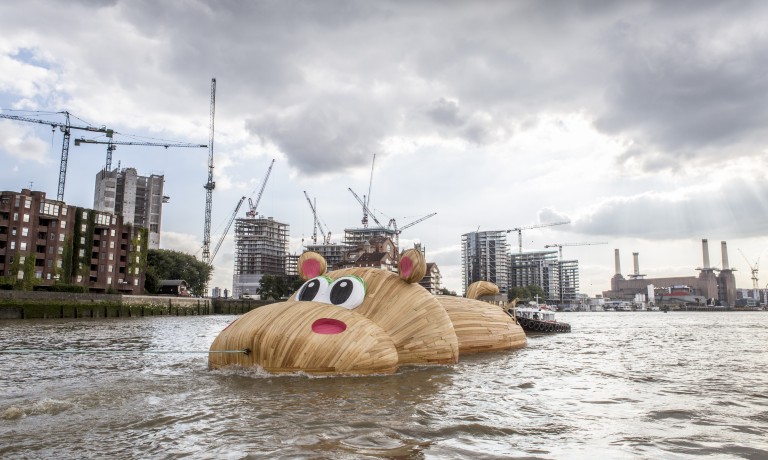
A giant hippo is currently floating in the Thames. It goggly eyes and cartoon curves are a pop-art facsimile of  the real thing. Florentijn Hofman’s HippopoThames is totally unreal and rather improbable. But then the idea that a hippo would make its home outside the Houses of Parliament *is* improbable.

Except…

Hippos *did* swim in the Thames. In the last warm-stage of the current Ice Age (we’re in a warm stage now), 125,000 years ago, the same species of hippopotamus that is now only found in Africa lived all over Europe. And that included the UK. Bones of hippos have been found across London, including Trafalgar Square. It lived alongside lions, straight-tusked elephants, hyaenas and rhinos. Yes, once upon a time there Trafalgar Square had actual, real-life lions.

IMG_0181

A Hippo tusk from Trafalgar Square, London. (c) Natural History Museum.

I talked about this, and other aspects of prehistoric London, yesterday at a special HippopoThames-linked event at the Doodle Bar in Battersea as part of the Totally Thames Festival. The poet Tom Chivers and Guerrilla Geographer Dan Raven-Ellison spoke as well, and our aim was to explore the changing nature of the River Thames, its natural — and unnatural — history in the past, present and future.

I covered the past. Tom brought us into historical time through poetry inspired by the lost tributaries of the Thames that flow beneath our feet, and the way that the ebb and flow of the Thames has shaped our modern city. His poems were introspective, thoughtful and quite beautiful. Then Dan launched us into the future with his call-to-action to help make his vision of London as the world’s first National Park City, with is rich urban biodiversity and culturally important landscapes.

Together I hope we showed the ever-shifting nature of the River Thames, and challenged simplistic ideas of what ‘natural’ means. But also the Thames’ fundamental importance in making London what is today. And, if course, making HippopoThames that ever-so-slightly less improbable.

Image credit (top): HippopoThames by Florentijn Hofman at Nine Elms on the South Bank © Steve Stills

Tucking Baby Lyuba in for her Journey Home

Mammoths: Ice Age Giants! is over and baby mammoth Lyuba is returning home to the Shemenovsky Institute in the Yamal-Nenets region of Siberia.

Lyuba is an almost perfectly preserved mammoth baby who, despite being healthy and well-cared for (the milk remains in her stomach show she had recently suckled from her mother), met an untimely end when she fell into a quick sand-like bog or pool. That same fate however led to her being so well-preserved, frozen in the permafrost for 42,000 years.

Having been thoroughly scanned, sampled and autopsied in the name of Science, Lyuba was preserved in the same way as Lenin so that she could go on public display. The Natural History Museum was the first time she had gone on display in Western Europe.

You can see me telling CBBC’s Newsround about Lyuba & the Exhibition here.

I wasn’t there when she arrived at the NHM (I was doing publicity for the exhibition on Start the Week instead – see this post), so I missed the emotional unwrapping of Lyuba by Adrian Lister. And even though it was still pretty special to see her even through a glass case, I was frankly rather jealous. I wanted to smell her, and look at her eyelashes, and get a really close look at her exquisite trunk.

So I wangled an invite to her ‘de-install’ on September 8th. Or as I prefer to think of it, the official tucking-up of Lyuba for her journey home.

And she was indeed beautiful, lying in her travelling case amidst layers of protective padding, her eyes closed as if she really was asleep. I can tell you that she didn’t smell at all. Perhaps the faintest hint of Siberian tundra in the summertime, but I may have imagined that.

Start the Week: Alien Invaders!

While baby mammoth Lyuba was being unwrapped at the Natural History Museum by my boss Adrian Lister, I was at Broadcasting House for Start the Week, to discuss the thorny subject of Alien Invaders. Not the out of space kind but the movement of animals across the globe, and the emotional subject of the value of native vs non-native species.

You can listen to the programme here.

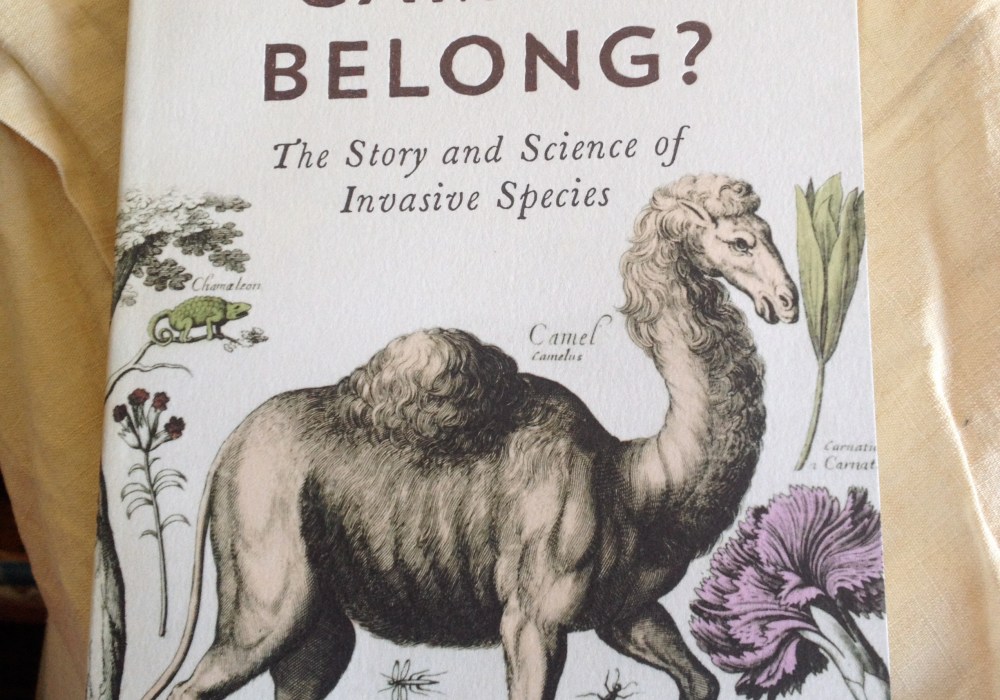
On the programme with me were: Ken Thompson, whose new book Where do Camels Belong? addresses these issues head-on; Monique Simmons from Kew, an organisation tasked with minimising the UK’s risk from invasive plant species; and John Lewis-Stempel, whose new book The Private Life of an English Field mourns the loss of traditional farming methods — and a number of well-loved, if non-native species alongside. I gave a palaeontological perspective to the discussion. Plus a preview of Mammoths: Ice Age Giants! and some bonus dwarf mammoths.

I never really felt the discussion really took off – but it was fun nonetheless. In particular I felt that Ken (on the program and in his book) was a little bit naughty in shifting effortlessly between the idea of ‘non-native’ species and ‘invasive’ species. I agree that the idea of a ‘native’ British fauna is highly problematic, but it isn’t really fair to paint conservationists as idealogical zealots here: the species they most worry about are the invasive ones. The ones that swamp out all others, reducing local biodiversity and often causing other species to go extinct.

And yes, while species distributions change through time making the idea of a natural baseline highly era-specific, once you accept that maybe ‘natural’ isn’t the be-all and end all it is time for a more challenging discussion: what is it that we value about our environment and the species around us? What kind of world do we want to leave behind?

There aren’t any easy answers to that, but I suspect the answer isn’t throwing up our hands and doing nothing at all.

Ken’s book is really a long-form version of this paper by Mark Davis et al [££] from 2011, which he was a co-author on. It generated quite a number of responses from ecologists at the time: see this letter by Dan Simberloff [co-signed by 141 other scientists; ££]. If you have access to Nature, they are both well worth a read, as are the references they cite!


Shiny new website for TrowelBlazers — trowelblazers.com!

Check out the new and, if I do say so myself, absolutely gorgeous internet home of TrowelBlazers: trowelblazers.com

Thanks to Neil Monteiro, who did the web-design. My absolute favourite thing so far is how the circles in the homepage banner change with every page refresh. Most addictive…

*clicks refresh repeatedly*

[if you’re trying to click on — or refresh — the circles here, I’m afraid the picture up top is just a screen grab — you’ll have to go to trowelblazers.com instead!]

Rodents of Unusual Size…?

image

Rodents of Unusual Size? I don’t believe they exist*… At least, not in the way that some media outlets would have you think. Last week journalists reported A LOT on the possibility of giant sheep-sized rats evolving in the future. See herehere and depressingly** also here.

I was asked for comment by the BBC a couple of of times — the first time I refused as I was busy (I had 30 mins notice and at that point I had no idea what the story was about). Plus, it sounded like a tabloidy link-bait story where I would find it hard to get a complicated point across if the angle had already been established as ZOMG EVIL KILLER GIANT RATS OF THE FUTURE.

However, afterwards the guilt got to me. Surely this is *exactly* when I should be joining in the discussion & trying to improve the quality of coverage?

So when the next request came through I decided to make the time for the journalist’s questions. They were hard to answer in a way which satisfied me, as they felt like they were pushing me to provide quotes that would still miss what I felt was the fundamental point of the R.O.U.S. story: the impact of the Anthropocene, especially on biodiversity.

As Henry Nicholls blogged (thank you Henry!): the mass extinction crisis we are facing in the Anthropocene is no laughing matter.

As I have no idea if any of what I wrote will even be used, The BBC used some of my replies in this article. I thought I’d pop up my full reply here (typos included) so this effort actually goes *somewhere*. It’s one of the many examples of the ‘hidden service’ that researchers do for free all the time.

image

An imagined giant rodent of the future, from the Gallery of Evolution at the Royal Belgium Institute of Natural Sciences. Copyright RBINS. Thanks to Mark Carnall of the Grant Museum for bringing this to my attention.

* This, by the way, is a Princess Bride quote. Rodents of unusual size do indeed exist, and even larger ones have existed. Evolution is amazing like that.

** to clarify why I find this depressing, it is because of the focus on the giant rat aspect, rather than the broader topic of which species will be ‘ future ancestors’ (which is also an important story about which species are going extinct right now) and how they will give rise to many different sizes, and differently adapted descendents. This gets a brief mention, leaving the overwhelming impression that sheep-sized rats is all the future holds…

Dear [BBC journalist],

The museum press office passed on your questions to me. To give you some background to my expetise, my research investigates the evolution of dwarf elephants (now extinct) that used live on islands like Sicily, Malta, Cyprus and Crete (e.g. see here). Interestingly, on islands while large mammals such as elephants and hippos evolve to become smaller (1m-tall adult elephants!), small mammals like rodents evolve to become bigger. But no island rat has approached anywhere near the size of a sheep.

The sort of evolution scenarios that Dr Zalasiewicz is speculating about would occur over huge swathes of time – tens of millions of years. Those sorts of timescales would allow for a myriad of wondrous forms to evolve: just look at the enormous diversity of the mammals that have evolved in the last 65 million years. I only have the University of Leicester press release to go on, but it seems to me that Dr Zalasiewicz has set up an interesting thought experiment, but one that is quite specific in its scenario and doesn’t lend itself to the broader Qs you have asked. Hence my answers wont fit perfectly with your questions I’m afraid.

Q8: Is there anything else he/she would like to add on the subject? 

It’s really fun to speculate about what the distant future might hold for the evolution of life on earth – the possibilities are endless. But we know from the fossil record that it takes, on average, ten MILLION years for life on Earth to bounce back from a mass extinction event. So while it is fun to think about the wondrous new forms that might arise, it is far more chilling to think of the species we are losing right now, and how long it will take to replace them. Certainly, given the average duration of a species, no human would get to see this imagined future ecosystem.

Q1: If certain animals went extinct because of climate change, would the evolutionary principle of niche-filling really extend to just one taxon?

Q2: Or would it be more wide spread with lots of other animals rushing to fill the space? (like after the KT extinction)


Only if all species bar one went extinct. Any species surviving an extinction event may eventually evolve to fill empty ecological niches. So the question is really “Which species are currently the most vulnerable to extinction” (because we’re set to lose those) and “which species are not at risk at all” (because that what will be left for natural selection to work on, the ancestral species of the future).

Q3: Would rats really be the ideal candidates for the taxa that would fill any ecological gaps?

Certain rat species, like the brown rat Rattus norvegicus, have a large, globally distributed population, and so are very far from extinction right now. The brown rat is also a generalist, flexible in its diet and ability to live in different environments – factors key to its success as an invasive species across the world.


Q4: or is their current niche too much of a success for them to need to adapt?


The crux of this question is time: in the very short-term, as we are seeing with invasive rat species today, rats are able to spread into unoccupied niches because they are generalists. Once in a new niche, natural selection continues to act – hence on islands, rats tend to evolve to be come a little bit larger. This might occur over hundreds to thousands of years. But when you zoom out to 100 million years in the future, we aren’t just talking about evolutionary changes in the rat – but the whole environment, throwing up new challenges the whole time. Continental drift; new mountain ranges; significant changes in climate; unpredictable catastrophic events like a meteor hit. And set against all this a continuous, complex evolutionary interplay between individuals competing for space to live, eat and breed. This is what Dr Zalasiewicz is talking about – but when you get to this stage, it makes no sense to call that theoretical sheep-sized animal of the future a ‘rat’ at all. It may have had a rat as an ancestor, but it will be something totally new, in a different ecological niche.

Q5: As global warming continues would an increase in global temperatures (and CO2) due to climate change result in animals getting bigger?

Q6: or would animals actually be likely to get smaller?


It’s impossible to generalise in such a way: What animals? Where? Over what timescales?

The size of an animal affects everything about it – where it can live, how it moves, what it can eat, how many offspring it can have, and how fast it can have them. This means that the size of an animal is a trade-off between all these things, and will evolve to best fit the ecological niche available to it.


Q7: Apart from the famous KT extinction, are there other examples of certain species/ groups filling an ecological niche after an extinction event?


Many. For example, the biggest mass-extinction event – the Permo-Triassic extinction, or the “Great Dying”, approx 250 million years ago – killed up to 97% of all life on Earth. It took up to 20 million years for life to recover in terms of species number and diversity – on land, some of the groups that were very successful were the Archosaurs, a group which includes the dinosaurs (including birds!) and crocodiles. The dinosaurs would go on to to diversify into a wide range of ecolgical niches.

Cosmic Genome LIVE at the Conway Hall

Last night Brenna Hassett and I represented TrowelBlazers at the Cosmic Genome LIVE event to celebrate the 15th Anniversary of the London Skeptics in the Pub group. It was a lot of fun to talk Six Degrees of Dorothy Garrod, Dorothea Bate, Hitler-defying Halet Çambel et al. alongside Robin Ince, Helen Arney, Adam Rutherford and Steve Jones amongst others.